
Resting Respiratory Rate
How Calmly Your Body Meets Its Demands

ⓘ This is for informational purposes only. For medical advice or diagnosis, consult a professional.
You breathe about 20,000 times a day. Most of them happen on autopilot while you’re focused on emails, errands, or Netflix. But there’s more to it, though. How you breathe (and how often), says more about your stress, recovery, and resilience than most people realise.
Take a deep breath, and let’s dive in!
What Is Resting Respiratory Rate?
Simply put, it’s the number of breaths you take per minute. It shows how hard your body has to work just to keep the lights on while you’re resting.
Here’s how to track it:
Smart Wearables: Most watches track this automatically while you sleep (the most accurate time to measure).
Manual Check: Sit quietly for one minute and count your “inhale-exhale” cycles.
The Gold Standard: To get a real baseline, look at your numbers when you are at complete rest, calm, and unstimulated.
What’s “Normal”?
Everyone is different, but here is the general roadmap for a healthy adult at rest:
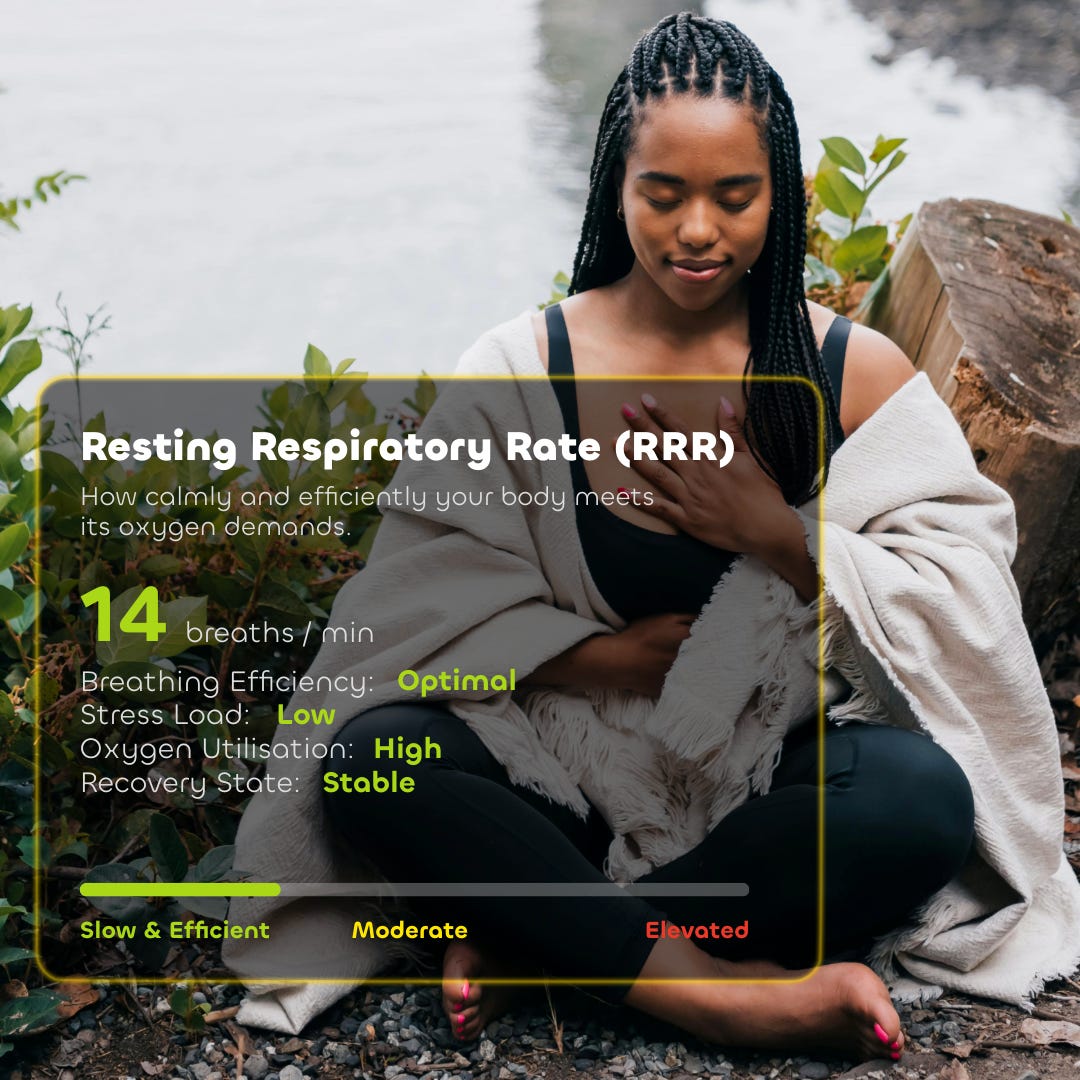
12 - 20 breaths per minute is considered normal and means you’re generally in the standard ballpark.
12 - 16 breaths per minute is the optimal range and means your nervous system is likely well-optimised.
If you’re pushing 20 or more breaths per minute, it might be a warning: a signal of stress, illness, or over-training.
If you’re familiar with the dashboard of your car, you will rate to this analogy. If your heart rate is the engine's RPM, your Resting Respiratory Rate is the idle speed. If you’re red-lining while sitting at your desk, you’re burning fuel you’ll need later.
The Red Flags: Watch for trends rather than one-off spikes.
The Science: Why it Matters
Breathing is a two-way street with your nervous system:
The Gas Pedal: Fast, shallow breathing tells your brain you’re in danger (the “Fight or Flight” response).
The Brake: Slow, deep breathing tells your brain it’s safe to relax (the “Rest and Digest” response).
If your resting rate is always high, your body thinks it’s under a constant, subtle threat. This drains your energy, ruins your sleep, and makes it harder to focus. Efficient breathing isn’t about taking bigger breaths; it’s about taking better ones.
How to Lower Your Rate (And Feel Better)
This is one of the few health metrics you can actually change in real-time. Here is how to move the needle:
👃 Use Your Nose: Nasal breathing filters air and improves oxygen intake. Try to keep your mouth closed during the day and during light walks.
📉 The “5-Minute Reset”: Practice taking only 4–6 breaths per minute for five minutes a day. It’s like a workout for your nervous system.
🏃 Get Moving: Improving your cardio (even just brisk walking) makes your heart and lungs more efficient, lowering your “idle” speed.
🪑 Sit Up: Slumping compresses your diaphragm. If you can’t expand your lungs, you have to breathe faster to get the same amount of air.
💤 Guard Your Sleep: High overnight breathing rates are often a sign of poor sleep quality.
Share The Good Stuff
If this article made you pause, reflect, or see your body a little differently, there’s a good chance someone in your life would appreciate it too. If someone came to mind while you were reading this, consider gifting them a subscription today. It might just be the nudge they need to listen to their body a little more closely, and become better, every day.
Notifications On-The-Go
We’ve made it even easier to stay connected. For quick reads, performance tips, and updates from the Optimised Humans community while you’re on the move, join our WhatsApp Channel. You’ll get bite-sized insights, reminders, and early access to new articles — all delivered straight to your phone. Follow the link below and stay in the loop, wherever you are.
Remember to turn on notifications for the channel.