
Resting Heart Rate
What your heart says about how you live

ⓘ This is for informational purposes only. For medical advice or diagnosis, consult a professional.
Think of your Resting Heart Rate (RHR) as the "check engine light" for your body, but way more helpful and a lot less scary.
If sleep is the foundation of your health, your RHR is the first clear signal that the foundation is actually holding steady. It’s a quiet, daily report card on how you’re handling the world.
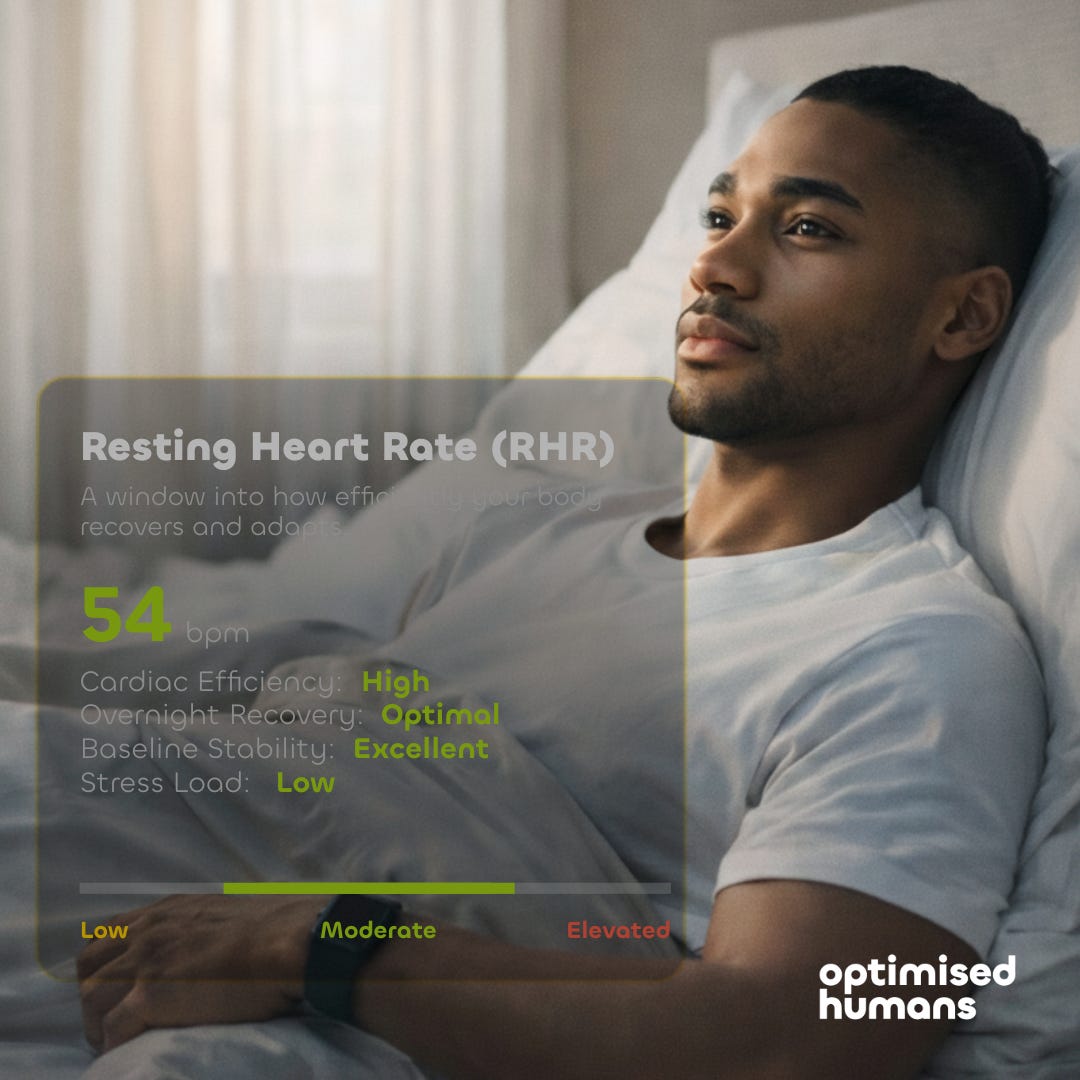
Your Heart Is Always Listening
Most people think their heart rate only matters when they’re huffing and puffing on a treadmill. In reality, your heart is a constant observer of your lifestyle. It doesn’t just respond to your workouts; it responds to your life.
Your RHR is influenced by the invisible parts of your day:
The Quality of Your Sleep: Did you actually recover, or just go unconscious?
Stress Management: Are you calm, or is your nervous system stuck in “fight or flight”?
Consistency: It’s not just about the big gym sessions; it’s about how often you move throughout the day.
Recovery: Did you give your muscles (and your mind) the downtime they earned?
What Exactly Is RHR?
Simply put, RHR is how many times your heart beats per minute while you’re doing absolutely nothing. It’s the “baseline cost” of keeping you alive.
How to catch it in the act:
The Tech Way: Use a smartwatch or ring (it does the math while you sleep).
The Manual Way: Check your pulse the old-fashioned way.
The Golden Rule: For the most honest number, check it first thing in the morning before you even get out of bed.
What’s A “Good” Number?
There is no single “perfect” score, but here is the general neighbourhood:
Average Adult: 60–80 bpm
Fit & Active: 50–60 bpm
Elite Athlete: 40–50 bpm
The Real Goal: You want a number that stays stable or slowly trends downward over time. If it spikes suddenly, your body is trying to tell you something.
The Science: Why Should You Care?
A lower RHR means your heart is efficient. It’s strong enough to pump more blood with less effort. A higher RHR means your heart is working overtime just to keep the lights on.
What pushes the needle?
📈 What Makes it Spike: Stress, dehydration, a looming cold, that extra glass of wine, or a terrible night’s sleep.
📉 What Brings it Down: Better cardio, consistent sleep, and actually taking time to relax.
Remember: RHR isn’t just a fitness stat; it’s a “stress bucket” meter. It shows the total load of your life: work, gym, and emotions combined.
Daily Habits For A Happier Heart
If you want to optimise your RHR, you don’t need a radical overhaul. Small, boring habits win the race:
Move Gently: You don’t have to sprint. Walking and easy cycling strengthen the heart without burning you out.
Protect Your Sleep: One bad night shows up on the heart rate monitor almost instantly.
Drink Water: When you’re dehydrated, your blood gets “thicker,” and your heart has to push harder.
Breathe: Five minutes of intentional breathing can switch your nervous system from “Panic Mode” to “Power Down.”
Balance the Hard Stuff: For every high-intensity workout, make sure there’s a recovery day to match.
Notifications On-The-Go
We’ve made it even easier to stay connected. For quick reads, performance tips, and updates from the Optimised Humans community while you’re on the move, join our WhatsApp Channel. You’ll get bite-sized insights, reminders, and early access to new articles — all delivered straight to your phone. Follow the link below and stay in the loop, wherever you are.
Remember to turn on notifications for the channel.
Share The Good Stuff
And if this article made you pause, reflect, or see your body a little differently, there’s a good chance someone in your life would appreciate it too. If someone came to mind while you were reading this, consider gifting them a subscription today. It might just be the nudge they need to listen to their body a little more closely, and become better, every day.