
Heart Rate Variability
Understanding the Key to Better Recovery

ⓘ This is for informational purposes only. For medical advice or diagnosis, consult a professional.
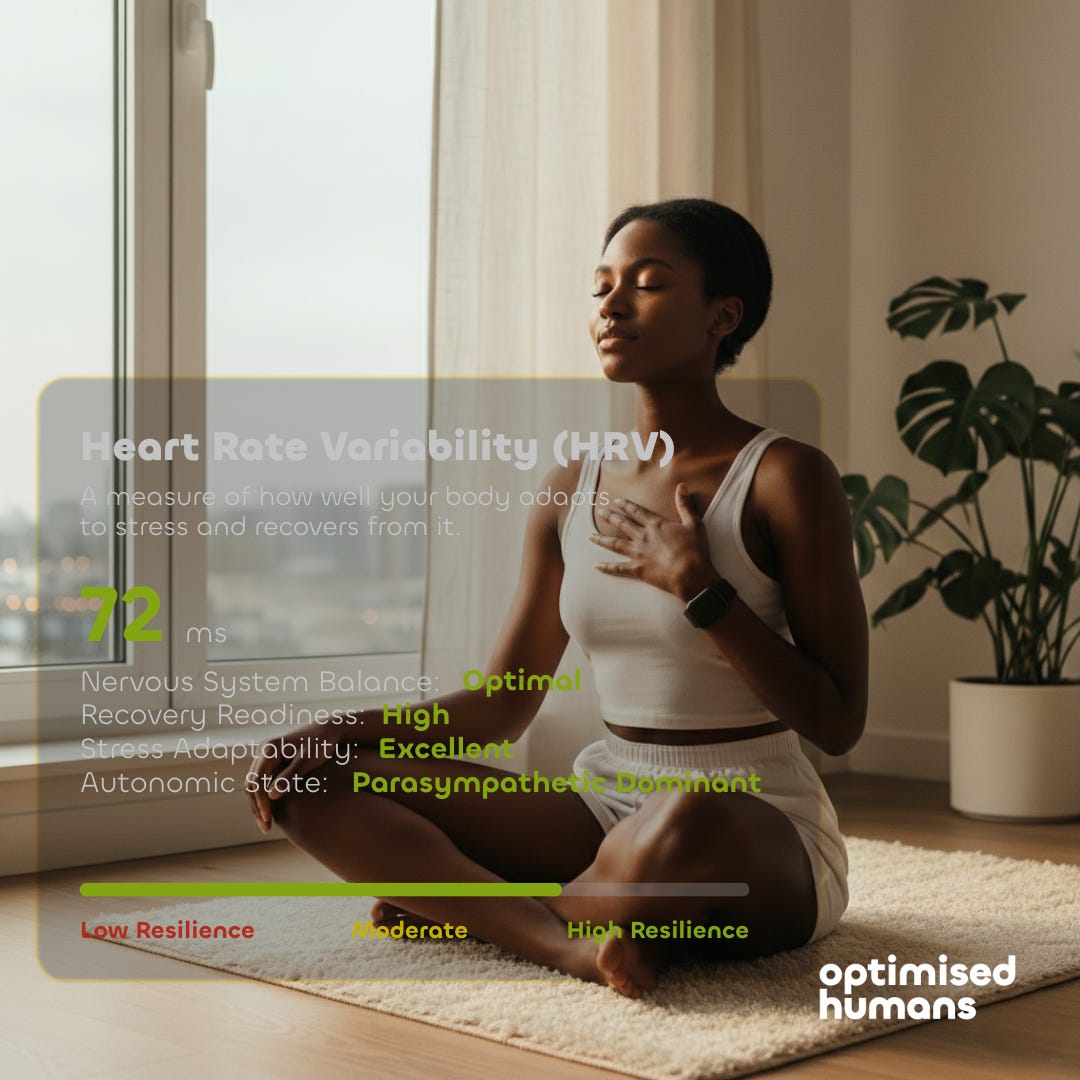
Think of Heart Rate Variability (HRV) as your body’s internal “stress thermostat”. While your pulse tells you how fast your heart is beating, HRV tells you how well your body is handling life.
Let’s get into how.
What Exactly Is HRV?
Most people think a steady heartbeat is like a metronome: perfectly rhythmic. In reality, a healthy heart is slightly “irregular”.
If your heart rate is 60 beats per minute, those beats don’t happen exactly every second. There might be 0.9 seconds between two beats and 1.1 seconds between the next. HRV is the measurement of those tiny gaps in milliseconds (ms).
High HRV: Your heart is “flexible” and ready to react to changes. This is a sign of good recovery and fitness.
Low HRV: Your heart is “stiff” or stuck in a steady rhythm. This usually means your body is under stress, tired, or getting sick.
The Science: Fight vs. Flight
HRV is a window into your Autonomic Nervous System, which has two modes:
The Gas Pedal (Sympathetic): Kicks in during stress, exercise, or danger. It makes your heart beat like a steady drum.
The Brake (Parasympathetic): Kicks in when you are resting, digesting, and recovering. It introduces those healthy variations between beats.
High HRV means your “Brake” is working well, allowing your body to switch into recovery mode easily.
What Is A “Good” Score?
There is no single “perfect” number because HRV is highly personal. Some people naturally sit at 30ms, while others are at 100ms.
The goal isn’t to beat someone else’s score; it’s to monitor your own baseline.
Good sign: Your score is stable or slowly trending upward over weeks.
Warning sign: Your score suddenly drops. This often happens before you even feel symptoms of a cold or burnout.
How to Improve Your HRV
You can “train” your nervous system to be more resilient by focusing on these five areas:
Sleep Consistency: The #1 factor. Going to bed at the same time stabilizes your system.
Smart Training: Don't go "all out" every day. Mix intense workouts with recovery walks.
Stress Control: Practices like deep breathing or meditation "force" the body into recovery mode.
Limit Alcohol: Even one drink can tank your HRV for 24–48 hours.
Hydration & Diet: A fuelled, hydrated body spends less energy on "maintenance" and more on recovery.
Notifications On-The-Go
We’ve made it even easier to stay connected. For quick reads, performance tips, and updates from the Optimised Humans community while you’re on the move, join our WhatsApp Channel. You’ll get bite-sized insights, reminders, and early access to new articles — all delivered straight to your phone. Follow the link below and stay in the loop, wherever you are.
Remember to turn on notifications for the channel.
Share The Good Stuff
And if this article made you pause, reflect, or see your body a little differently, there’s a good chance someone in your life would appreciate it too. If someone came to mind while you were reading this, consider gifting them a subscription today. It might just be the nudge they need to listen to their body a little more closely, and become better, every day.