
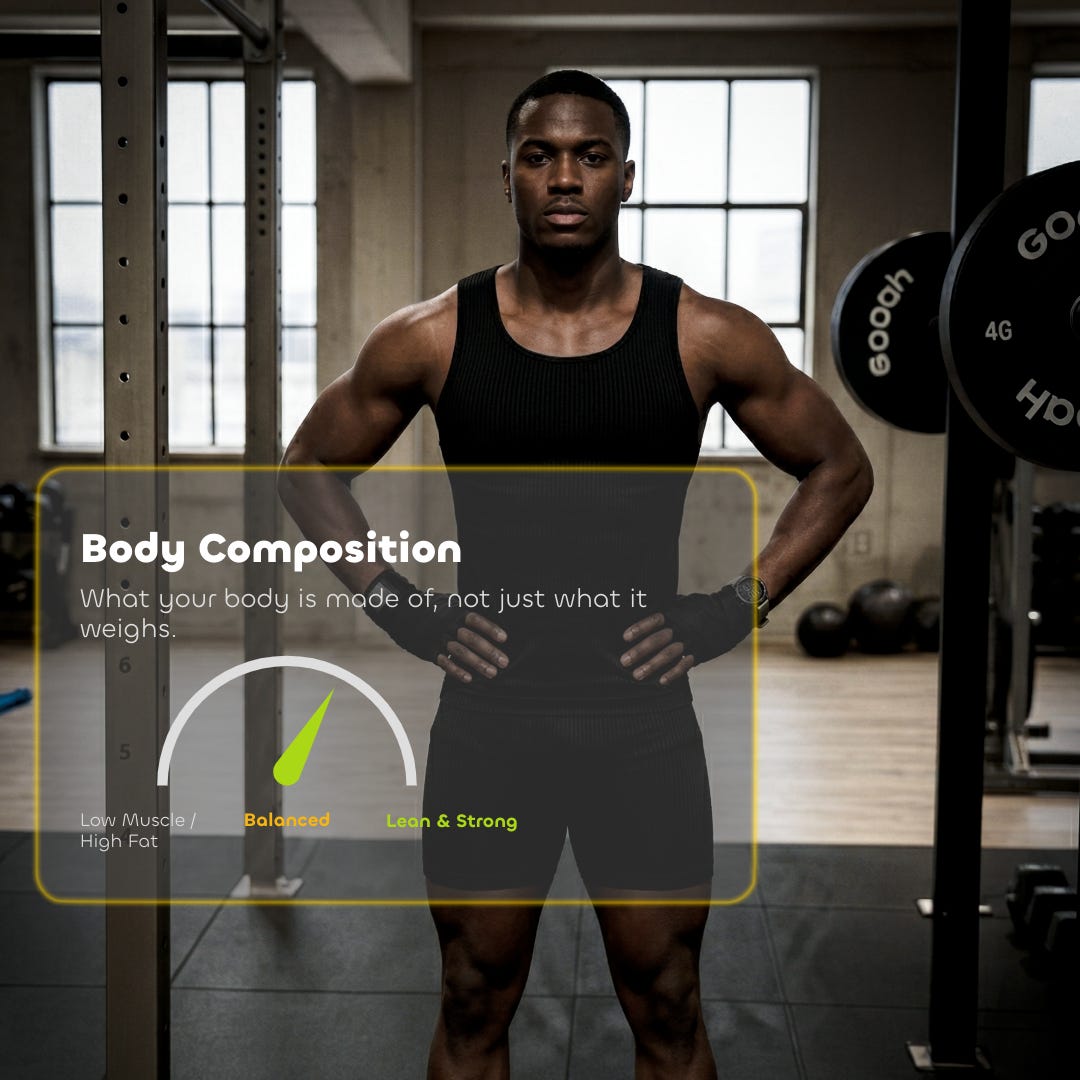
Body Composition
How Your Body Is Built, Not Just Weighed

ⓘ This is for informational purposes only. For medical advice or diagnosis, consult a professional.
Imagine two people: Kobby and Elorm. They both stand 5’10” and weigh exactly 84kg.
On paper (and according to a standard BMI chart) they are identical. But in reality, Kobby struggles with midday fatigue, back pain on-and-off, and clothes that feel increasingly tight around the waist. Meanwhile, Elorm feels powerful, recovers quickly from a weekend hike, and has a resting heart rate ten beats lower than Kobby’s.
The difference… is in their body composition.
While Kobby’s weight is primarily composed of stored fat and lower muscle mass, Elorm’s weight is driven by dense muscle and bone.
The lesson: Your body isn’t a single number to be shrunk. It’s a biological system to be built.
Let’s get into it!
Understanding the Metrics
Body composition breaks your total mass into two primary categories:
Lean Mass: Muscle, organs, bone, and water.
Fat Mass: Essential fat (required for life) and stored fat (energy reserves).
It gives a clearer picture of your physical structure than weight alone.
How it’s measured:
DEXA scans (high accuracy)
Bioelectrical impedance scales (home devices)
Skinfold measurements
Waist-to-hip ratios and visual assessment
No method is perfect, but each is more informative than the scale alone.
Defining “Optimal”
There is no universal “ideal”. Optimal composition is the intersection of functionality, health, and sustainability.
General Health Ranges: Men (~10–20% fat); Women (~18–28% fat).
The Qualitative Test: Optimal is reached when you feel strong, recover quickly, maintain stable energy, and can sustain your lifestyle without extreme restriction.
The Science
Your body is metabolically active tissue, not a static weight. Composition is the primary driver of your internal health.
The Role of Tissue
Muscle (a metabolic asset): It increases your resting metabolic rate, improves insulin sensitivity, and protects joints.
Fat (an endocrine organ): It regulates hormones and protects organs. Visceral fat (stored around organs) is the primary driver of disease risk, not subcutaneous fat.
What Affects Body Composition
Composition isn’t just “calories in vs. calories out.” It is a reflection of your entire lifestyle:
Positive Drivers: Resistance training, high protein intake, quality sleep, and stress management.
Negative Drivers: Chronic cortisol (stress), sedentary behaviour, and extreme “crash” dieting which often sacrifices muscle for weight loss.
Let’s Reframe
Traditional fitness focuses on shrinking. True health focuses on building. Progress is not eating less to weigh less; it is moving better to build more capacity. Muscle is your longevity insurance; fat is your energy buffer. Balance is the goal.
High-Leverage Habits
To optimise your system, focus on compounding behaviours rather than short-term fixes:
Prioritise Strength: 2–4 resistance sessions weekly to signal muscle retention/growth.
Eat for Structure: Prioritise protein and whole foods to provide the building blocks for lean mass.
Non-Exercise Movement: Daily steps and general activity often impact fat loss more than a single gym hour.
Protect Recovery: Muscle tissue is repaired and metabolic health is regulated during deep sleep.
Audit Your Progress: Move away from the scale. Track strength gains, how clothes fit, and energy levels.
Share The Good Stuff
If this article made you pause, reflect, or see your body a little differently, there’s a good chance someone in your life would appreciate it too. If someone came to mind while you were reading this, consider gifting them a subscription today. It might just be the nudge they need to listen to their body a little more closely, and become better, every day.
Notifications On-The-Go
We’ve made it even easier to stay connected. For quick reads, performance tips, and updates from the Optimised Humans community while you’re on the move, join our WhatsApp Channel. You’ll get bite-sized insights, reminders, and early access to new articles — all delivered straight to your phone. Follow the link below and stay in the loop, wherever you are.
Remember to turn on notifications for the channel.